Musculoskeletal imbalances are dysfunctions that can increase the risk of chronic pain, such as neck pain, shoulder pain, and more. According to the World Health Organization, low back pain is the most prevalent musculoskeletal condition and the single leading cause of disability worldwide. Given the prevalence of the problem, various methods have emerged to treat these conditions, such as bodywork, stretching, and yoga. While these techniques may offer temporary relief, they don’t address what causes these imbalances and how we might truly resolve them.
In youth, our backs function effortlessly — yet by middle age, even those in good health often struggle with sitting comfortably, lifting weights, or performing routine tasks. This is not simply the result of injury or weakness in specific muscles. As we age, our bodies do not function with the lightness and ease we experienced as children. Like other animals, we possess a remarkable and efficient musculoskeletal design that makes it possible to move easily and efficiently. When something goes wrong, conventional wisdom directs our focus to the specific problem, not realizing that we have interfered with this larger system and its ability to function. How this system works — and why it holds the key to musculoskeletal difficulties — is one of the key subjects we study and teach at the Dimon Institute.
The Body’s Elastic Latticework
The usual view of muscles — and the view upon which most theories of movement are based — is that muscles contract to make movement possible. For example, when we lift an object, we must contract the biceps muscle, which flexes the arm at the elbow. Such a strategy is perfectly acceptable when we are performing a specific task, but it cannot account for how a child can sit, without any apparent effort, for hours at a time.
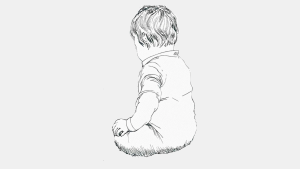
Fig 1: A child sitting effortlessly
In this case, muscles clearly maintain the support of the head and trunk, yet there is no strain in any of these muscle groups. Furthermore, the muscles do not seem to tire or to forcibly contract but remain pliable and toned. How is posture maintained so effortlessly? The answer is that muscles maintain the support of body parts, but they do so in the context of length.
Consider how the head maintains its upright position. The neck muscles must act upon the head to keep the head upright. If they did this by forcibly contracting, the head would be pulled back, which would put pressure on the spine and compromise the ability of the trunk to lengthen against gravity. As we can see in the child, this is not what happens. Instead, the head balances forward and, in doing so, counterbalances the action of the neck muscles.

Fig 2: A child sitting, head balancing forward with lengthening spine.
In this way, the neck muscles maintain the support of the head, but in the context of a dynamic state in which the head acts on the neck muscles, which remain lengthened, allowing both the neck and spine to remain lengthened.
This same principle can be observed everywhere in the body. The spine, for instance, is an inert bony structure and requires muscular support. But the muscles of the spine don’t simply pull on the spine by forcibly contracting; they are instead maintained in a lengthened state and, in this context, support the spine and trunk without actively contracting. Even the leg muscles, which stabilize the legs at the ankles, knees, and hips, do not simply shorten but are lengthened between bony attachments and, in this context, maintain the postural support of the body against gravity with a minimum of effort.

Fig 3: Diagram of muscle length in the human body.
But how is it possible for muscles to support the body by lengthening? The idea of muscles supporting the body through lengthening may seem contradictory since lengthening is not something a muscle can actively do — muscles can only shorten or contract. Even when a muscle is passively lengthened (as when we forcibly stretch our hamstrings), it cannot do anything positive in that state. Yet, lengthened muscles do contribute to bodily support by working in partnership with bones, creating opposing forces that produce total support — an arrangement described as a tensegrity structure.
Tensegrity: The Principle Behind How Muscles Work
To make this clear, think of what happens if you place a heavy pole on the ground and run guy wires from the ground to keep it from falling over. The guy wires support the pole, but simultaneously, the pole keeps the guy wires lengthened. In this case, the pole is doing the primary job of maintaining the tent’s support, but not entirely — much of the load is borne by the guy wires, which absorb the forces acting on the tent by resisting the tendency to be pulled apart.

Fig 4: A tent — a simple tensegrity model.
Such a dynamic architectural arrangement was given the name “tensegrity” by Buckminster Fuller, an engineer and architect who explored non-traditional ways of using building materials.1Fuller noted that many living structures, including plants and animals, utilize tensegrity principles in their designs, which are far more efficient, mobile, and lightweight than compression structures. The same principle applies to muscles, which could not possibly maintain postural support of the body simply by contracting, which is too costly and metabolically inefficient to be sustainable. Instead, nature found a much more efficient architectural principle in which muscles, connective tissues, and bones cooperate to form a pliable, mobile, lightweight structure, as we see in many vertebrates with their lithe, lightweight, mobile designs.

Fig 5: Tensegrity model of a rabbit.
The PNR System: A New Principle in Musculoskeletal Function
So how do the concepts of tensegrity and muscle length relate to musculoskeletal function? To support the body as a whole, muscles and bones work together as a total architectural arrangement to maintain an upright posture with a minimum of effort. If particular muscles are tight, trying to relax or treat them will not solve the problem because, as part of the body’s tensegrity design, individual muscles can function properly only in the context of the whole. When the larger system is restored, muscles throughout the body can resume their normal length, and the system as a whole can begin to work more efficiently, functioning automatically to maintain length and support with minimum effort.
This systemic coordination is the Postural Neuromuscular Reflex (PNR) system — a theoretical model first outlined in Neurodynamics: The Art of Mindfulness that redefines our understanding of the musculoskeletal system. The model is built on three elements: the organization of musculoskeletal support around the head and trunk, the principle of muscle length, and the response of muscles when the body begins to produce upright support at an automatic level. When we understand how the body is designed to work based on these principles, muscles do not strain but are naturally healthy and toned, joints function with maximum ease, breathing is full and unimpeded, and movement is effortless and light.
Together, these components form the basis for efficient movement and support, offering a revolutionary perspective on how the human body is designed to function. By focusing on the body’s inherent design, it provides a framework for restoring natural function and preventing dysfunction. If the muscles of the lower back are shortened, we can clearly identify how the musculoskeletal system has been compromised and how to establish a coordinated working of the parts. This is not a theoretical exercise but a practical guide for achieving efficient, pain-free movement based on a positive understanding of function and design. By learning to kinesthetically identify the underlying cause of the problem, the student can restore the natural tensegrity principles that support the lower back.
The human body is a machine of incredible potential and is designed to work perfectly. Our role is not to fix it but to understand and align with its natural principles. This perspective is not speculative but grounded in decades of observation and practical application with students and clients. In a world increasingly focused on quick fixes, this model challenges us to think differently — to see the human body not as a machine to be repaired but as a marvel of natural engineering, capable of extraordinary resilience and efficiency.
Dr. Ted Dimon is the Director of the Dimon Institute in New York City.
Genine L. Yarborough, Marketing Manager of the Dimon Institute, is based in New York City.