The human body is the most complex architectural/moving structure in the known universe, making possible a diverse and fantastic array of skilled activities. As upright bipeds, we can walk efficiently on two feet in any kind of terrain; we can run, throw, climb, fight, and perform acrobatics; when sitting we can write, fashion tools, create art, and play musical instruments; we can sing and speak. All these activities are controlled by the brain, which includes centers for vision, hearing, spatial awareness, language, face recognition, and more.
These structures did not develop out of nowhere; they are the result of a series of transformations in vertebrate evolution that began with the fish, progressed to land animals such as reptiles and quadrupeds and led, ultimately, to the amazing upright primate known as the human being. Each of these stages, in altered form, is reflected in our individual development as we develop in the watery environment of the womb, are born lying helplessly on our backs, learn to roll over, to push up on our arms, to crawl along the floor, to clamber and to walk upright, all these stages unfolding instinctively in our individual development as a reflection of our evolutionary heritage. At the end of this journey, we are capable of carrying out a fantastic array of activities, with incredible efficiency and skull.
The Need to Study Human Movement
Yet few of us are able, as adults, to sit effortlessly, to walk easily on two feet, or to use our hands at a desk in a coordinated and effortless way. We inherit a system of fantastic subtlety and complexity, yet it no longer works properly in the typical adult, as evidenced by the various forms of strain, collapse, and dysfunction that many of us experience by our twenties and even earlier. What is given to us by nature is lost through habit and must be regained through conscious effort.
It is in this context that the study of developmental movement—that is, the study of movement from the point of view of how we have evolved from simpler forms and progressed, over time, to our distinctly human upright form—has a special significance. Many of the body’s basic functions—our ability to sense what is happening in our muscles, our ability to sit, to walk on two feet, to use our hands—originated with simpler designs, evolving over time to the complex forms we see in mammals and particularly in humans. Identifying these simpler functions in ourselves, and working with them in a constructive way, plays a critical role in developing heightened awareness and increased command over these functions.
From Prone to Biped
One of the most basic procedures in developmental movement is to lie fully supported on the floor in the semi-supine or prone position (see the illustration below). In our upright human posture, we spend a great deal of time on two feet or sitting, and in both of these postures, tactile and proprioceptive input is limited to our feet, our sit bones, and other secondary contact points such as leaning back against a chair. This is not the case with infants, who are in constant contact with the floor and with another person. This whole body contact provides crucial tactile and proprioceptive feedback, which we restore when we lie prone on the floor. Most of us get this kind of feedback only when we collapse onto a couch, slump into a chair, or go to sleep. When we lie on the floor in the prone posture, we can provide this kind of contact in a very constructive way that helps to reduce tension and lower stress, providing a primitive tactile and proprioceptive input that is familiar to infants but which, as adults, we lose touch with.
Crawling on hands and knees is another key developmental movement (see the illustration below). In our upright form, the spine has four curves—cervical, thoracic, lumbar, and sacral. In the four-footed posture, the spine has only two—the long thoracic curve of the spine between fore and hind limbs and the counterbalancing curve of the cervical spine. In this position there is, functionally speaking, very little lumbar curve. The back is strong and integrated, the legs are flexed at the hips, the back is supported by both hind and forelimbs, and the head, which is cantilevered, is coming out of the back and leading in the direction of movement.
Placing ourselves in this position helps us to experience in a very direct way how the head and trunk function as a unit, and to see that crawling begins, not by advancing the limbs but with the head leading as the trunk rocks forward. With the head and trunk working as an integrated whole, we can learn to crawl effortlessly, with the limbs swinging underneath the advancing trunk, and without shortening or stiffening of neck, back, and ribs.
The Basic Stages of Movement
By exploring each stage in the developmental sequence—beginning with lying fully-supported on the floor, progressing to supporting ourselves on four limbs, and then crawling on all fours and clambering to the fully upright posture—we can learn to effect improvements in the working of the muscular system, gain insight into how to move more efficiently, and progress from more basic to more advanced forms of balance and support, without the help of a teacher or therapeutic aids.
Here are five of the basic stages of developmental movement:
-
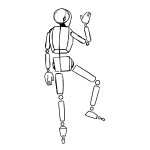
- 1. Prone and supine: lying fully supported on the ground
-
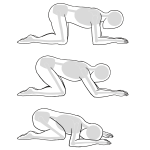
- 2. Primary crawling and foetal positions (elbows, knees, forehead)
-

- 3. Crawling on all fours
-
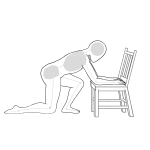
- 4. Clambering and four-footed support of the trunk
-

- 5. Rotational movements
Outcomes of Developmental Movement
Let’s now consider a few of the key benefits of developmental movement. First, it provides an invaluable aid to recovering basic aspects of mobility that are being lost in our modern sedentary lifestyle. Mobility is basic to wellbeing; yet in today’s sedentary cultures, the ability to sit on the floor, to squat, and to transition from the floor to standing has become foreign to many of us. Ask the average forty-year-old to get up from the floor and the point is clear: as we age, we lose mobility and can no longer move with the grace and ease of childhood. The study of developmental movement helps us to regain familiarity with these actions, and to recover the ability to perform them easily and effortlessly.
Second, the study of infantile postures provides basic feedback and support needed for maintaining musculoskeletal health. When we are standing, the only physical contact we have with the ground consists of three points of support on each foot. When we are prone or semi-supine, we have numerous fulcrums of support. These enable us, in a position of complete security, to allow muscles to let go between points of support, which also elicits supporting responses—i.e., having our elbows on the ground allows us to let go in the shoulders and widen the back; the forehead against the ground allows us to untwist and release the neck muscles; knees contacting the ground makes it easier to lengthen and release the thigh and hip muscles.
A third benefit of developmental movement is to reestablish balance of the nervous system. Sensory feedback forms the very foundation of our sentient experience, which precedes thinking as a form of knowing and experiencing the world and ourselves. When we perform basic developmental movements, we access this kind of sensory experience in a powerful and immediate way, returning to our most primal and elemental experiences as moving, sensing beings. Developmental movements provides a very direct means of balancing these systems, going far beyond remediation but provides ways of gaining control over these systems as a matter of conscious awareness and growth. Take time in supported positions to allow the nervous system to calm down.
Finally, through the study of developmental movement, one gains the ability to become more kinesthetically discriminating. When we are lying in fully supported positions, muscles that act on parts of the body parts can stop working, making it possible to identify, and gain control over, harmful patterns that interfere with natural support.
Conclusion
Human upright posture is the most complex movement system in the animal kingdom and evolved sequentially from earlier and more primitive forms of movement. Knowledge of developmental stages of movement is an invaluable aid in developing mastery over this complex system. By utilizing basic primitive postures and stages of movement, we can regain the postural support and heighten the sensory input required to recalibrate the system. We can learn to recognize and prevent harmful patterns of tension that interfere with upright support, making it possible to effect improvements in the working of the muscular system, to gain insight into how to move more efficiently, and to progress from basic to more advanced forms of balance and support—all at a more conscious level that elevates the performance of action to a higher level of awareness and control.
For more information on kinesthetic awareness in action, see Sensorimotor Awareness: A Kinesthetic Guide to the Body in Action (Dimon, 2025)
Developmental Movement, available in Spring 2026
Online study at the Dimon Institute:
The Developmental Movement Project, Autumn 2025
Developmental Movement, offered in Spring, 2026